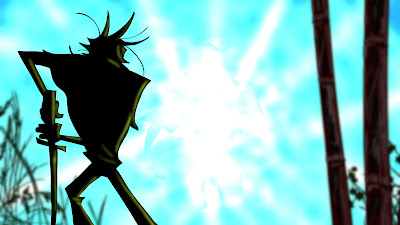
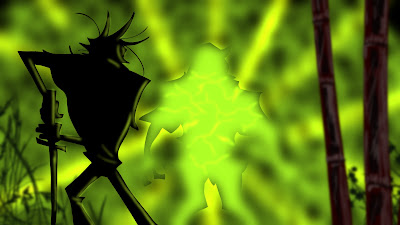
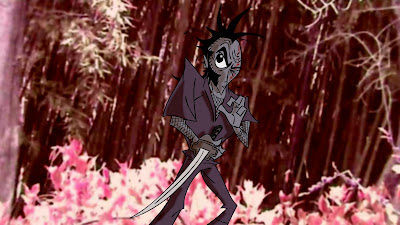
Bostie Boys - Scene 3 from Eddie Mort on Vimeo.
Tuesday, September 15, 2009
More Multiplane
Monday, September 7, 2009
More Bostie Boys Animation
Bostie Boys - scene 29A from Eddie Mort on Vimeo.
Everything here was done in Animate, and is a good example how the blur filters and camera can really lift a scene. The mast and rope in the foreground give a sense of depth courtesy of the multiplane camera; just a slight truck in really helps. The bathtub animation is a re-use from a previous post; I created a template of the animation in a previous scene, then assigned all the layers to a PEG so I could motion tween.
Thursday, July 23, 2009
Another advantage of having Drawing & Camera views side by side
As you can see, I can zoom in and out in the Drawing View to do my details or to paint, and at the same time - the Camera View stays the same such that I can always refer to the "bigger picture" while I draw. I can also alter my Camera View (hand tool, or zoom tool) without affecting my Drawing View. I think this is pretty cool.

In the timeline, my imported jpegs (for reference) are represented by the blue frames. Their layers are hidden right now. When I want to look at them, I disable my Drawing layers, and enable those Jpeg layers, which then show up in my Camera View on the right side.
BTW, I sketched using the Brush tool (Anti-Aliasing disabled in Open GL properties) with Tool Properties set to
so that the color is added under my black brushstrokes.I love this new Workspace! =)
Wednesday, July 22, 2009
Reorganizing my Workspace for Character Design
Yes, it is possible to vectorize images into Symbols, then expand the Symbols to make them visible in the Drawing View (this is if you want to trace your scanned artwork) but if I only wish to use my imported jpegs as visual reference while I am designing or drawing, then it makes no sense to vectorize them.
Francisco from ToonBoom offered a cool little tip - We can rearrange the modules so that both the Drawing and Camera Views are positioned side by side and visible at the same time.
This is a great idea for Character Designing: I can draw in one window (Drawing View), and refer to the imported jpeg in the adjacent window (Camera View).
*As we can't publicly display some of our work due to confidentiality agreements, this pic below is something I whipped up quickly for the purpose of this blog post.
I imported the "Character Lineup" .jpeg which is what you see in the Camera View on the right, and represented as a Symbol in the timeline below. I do my rough drawing on the left in the Drawing View, which will then be cleaned up and colored. Note that the Drawing layer on the timeline is "hidden"/disabled so that it doesn't show up in the Camera View. I have the Lightbox enabled so that I can still see it in the Drawing View.

Note also that I have shifted the Tool Properties, Color and Library modules over to the left side next to the Tool bar - this is just a personal preference.
To move modules around, grab the tab and drop it wherever you want it to go.
- If you drop it ON TOP OF another tab, you will be able to toggle between these tabs in the same module.
- If you drop your tab ON ONE SIDE of another tab, then you will have separately-docked modules.
- If you drop your tab anywhere else, it becomes a free floating module.
I like my new workspace for character designing. When animating, I would switch back to the Default/Animation workspace.
UPDATE: Here is a screencap video
Friday, July 10, 2009
Camera set-up & Motion Keyframes: What the manual doesn't tell you.
Bostie Boys scene (ToonBoom Animate) on Vimeo.
As you can see, there are 'motion tweens' happening with the waves, the clouds, characters' ears flappin' etc.The idea was to add a camera with multiplane set-up by putting BG layers in different z-axis positions, giving depth to the sky, clouds, sea etc. while everything is panning.
What we found was that in setting keyframes on the Camera Peg layer, the multiplane set-up did NOT carry through on the timeline beyond the first keyframe. (!!!!) We couldn't figure out why this was happening.
The problem was due to the motion tweened layers.
In Flash we are used to animating the looping symbols first - which are then nested inside a larger movie clip symbol for "camera". In TB Animate, the order in which things are done can sometimes be almost the opposite.
The solution to our problem was to set up the multiplane BG and camera first, BEFORE tweening anything.
Tuesday, June 30, 2009
Animate and Text
While I really enjoy creating backgrounds in Animate, one inconvenience is the absence of text. For the background below I had to actually create the text in Flash and then import into Animate as a .swf
One drawback was that the text needed to be broken apart in Flash so it would import properly (un-broken text sometimes wouldn't import at all, and on other occasions Animate would assign a different layer to each letter when imported!). Another option would be to create, and then import a .PSD file from Photoshop.
Anyone else got any preferred methods when working with text in Animate?